
Salt Lake City Traffic Ticket Records
Salt Lake City traffic ticket records are handled through the Salt Lake City Justice Court at the John L. Baxter Courthouse. If you received a citation in the state capital, you can look up your case, pay fines, or explore resolution options through the city court system. This page covers how to search Salt Lake City traffic records, what options are available after a citation, and how to access case information online or in person.
Salt Lake City Quick Facts
Salt Lake City Justice Court
The Salt Lake City Justice Court handles traffic citations issued within city limits. It is located at the John L. Baxter Courthouse in downtown Salt Lake City. This court has jurisdiction over Class B and C misdemeanors and all infractions, which includes most traffic violations. Serious traffic offenses, such as felony DUI or vehicular assault, go to the Third District Court in Salt Lake County. For the large majority of everyday citations, the city justice court is where you need to go.
| Court | Salt Lake City Justice Court |
|---|---|
| Address | 333 S 200 E Salt Lake City, UT 84111 |
| Phone | (801) 535-6300 |
| Website | slc.gov/courts |
| Online Payment | utcourts.gov/epayments |
The court is accessible by TRAX and bus lines. Security screens all visitors, so bring a valid photo ID. If you need ADA accommodations, the court will make arrangements. Call (801) 535-6300 in advance to ask about accessibility services at the Salt Lake City Justice Court.
The Salt Lake City Courts page at slc.gov/courts has links to pay citations, request hearings, and find general court information for traffic tickets in Salt Lake City.
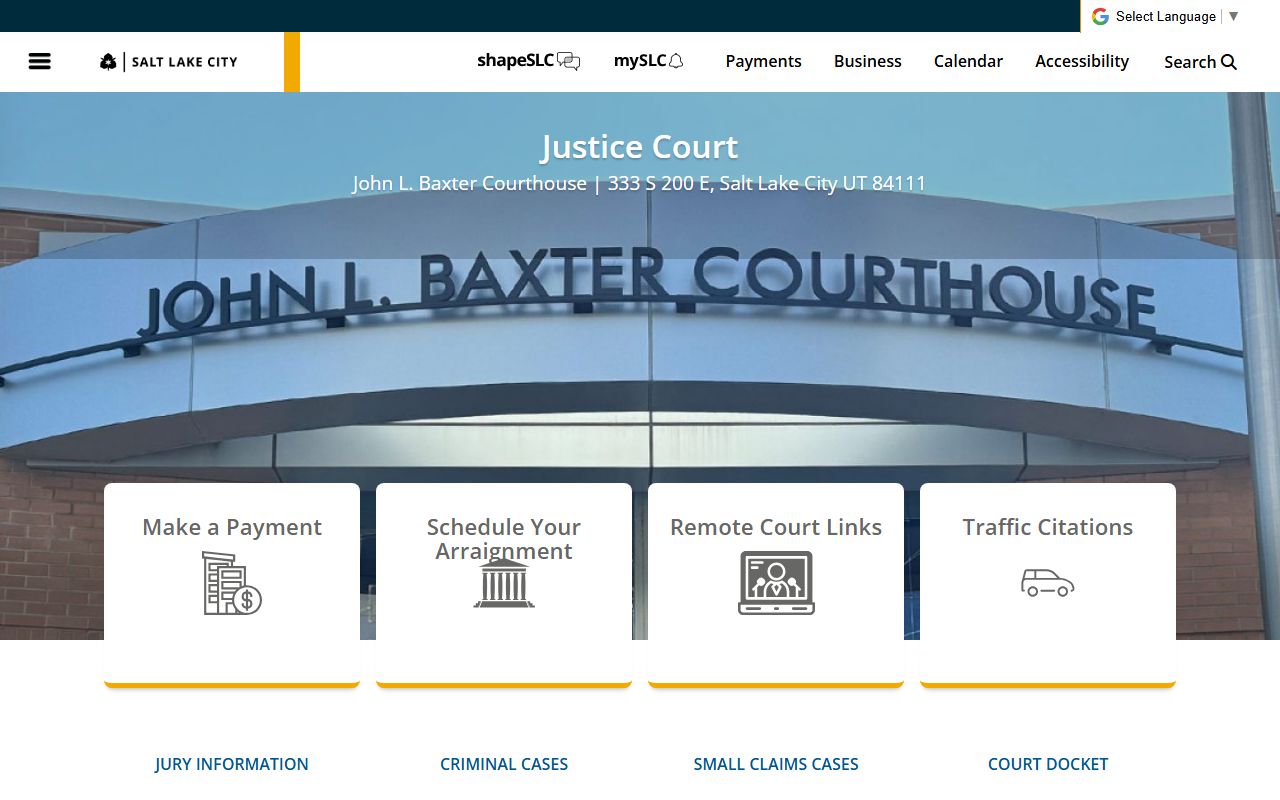
This portal also connects to the city's traffic citation system where you can look up case status and access resolution information.
How to Pay or Look Up a Salt Lake City Traffic Citation
You have several ways to deal with a traffic citation in Salt Lake City. Online payment is the fastest option for most people. You can pay through the Utah Courts online payment system at utcourts.gov/epayments. You will need your citation number or case number to use the system. Payments process quickly and you get a confirmation right away.
To look up a case online, use the MyCase portal at utcourts.gov/mycase. You can search by name, case number, or citation number. The system shows case status, scheduled hearing dates, and what actions have been taken. MyCase covers the Salt Lake City Justice Court and all other Utah state courts. This is the main public access tool for traffic ticket records in Salt Lake City.
You can also pay by phone at (801) 535-6300 during business hours. In-person payments are accepted at the John L. Baxter Courthouse. Mail-in payments are allowed as well, but allow extra time for processing. Whichever method you choose, keep your receipt or confirmation number. You will need it if there is ever a question about whether the fine was paid.
The SLC traffic citations page at slc.gov/courts/traffic walks you through the options for handling a Salt Lake City traffic ticket, from online payment to requesting a hearing.
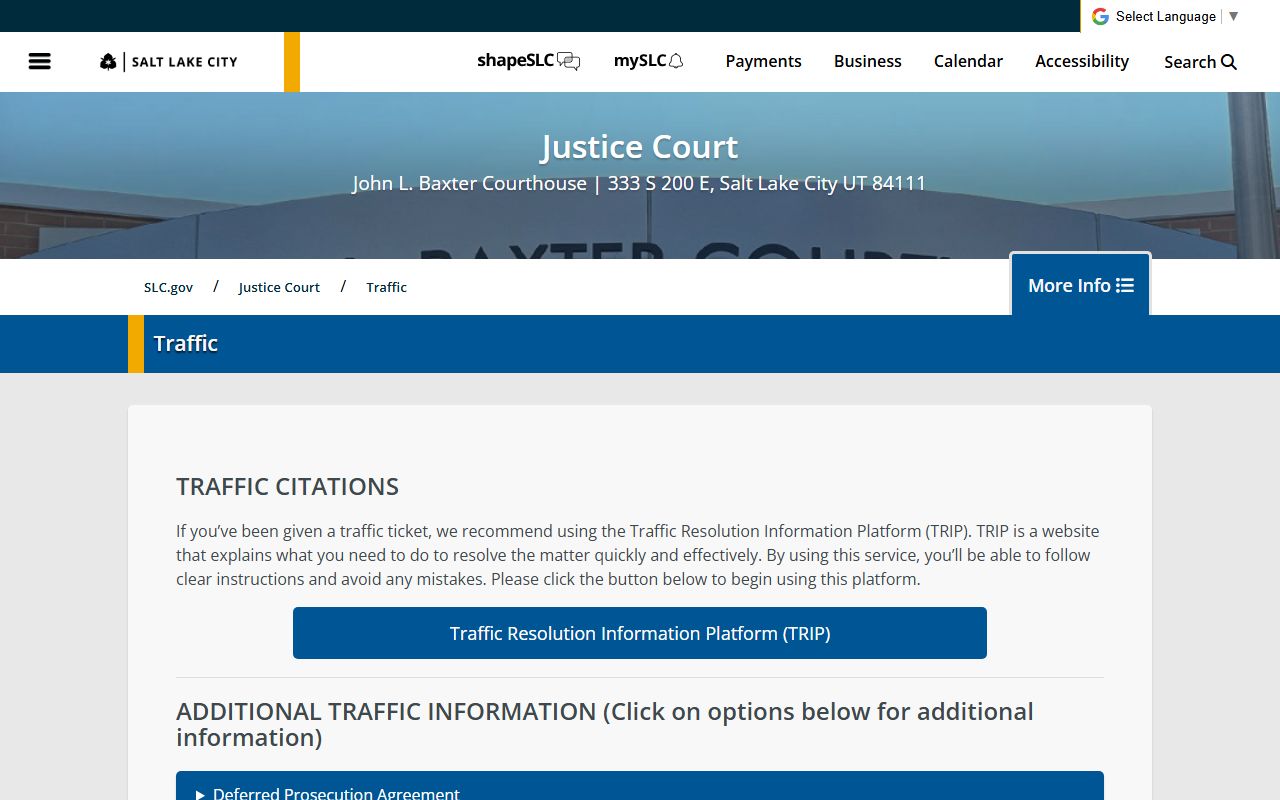
The page outlines timelines and what happens if you miss the response deadline on a Salt Lake City traffic citation.
Traffic Resolution Options in Salt Lake City
Salt Lake City Justice Court offers a Traffic Resolution Information Platform, known as TRIP. This system lays out the options you have when you get a traffic citation in the city. Not every option is available for every ticket, but most standard moving violations qualify for at least one alternative to a straight guilty plea. Understanding these options can make a real difference in whether a citation shows up on your driving record.
The three main resolution paths for Salt Lake City traffic tickets are deferred prosecution, plea in abeyance, and standard payment. A Deferred Prosecution Agreement lets you avoid entering a guilty plea. If you complete the conditions of the agreement, the case is dismissed and nothing is reported to the Utah Driver License Division. A Plea in Abeyance requires a guilty plea, but the plea is held and the case is dismissed once you complete the conditions. The DLD is notified of a dismissal, not a conviction. Standard payment means paying the fine as a conviction, with points assessed to your driving record.
Traffic School is another option for some Salt Lake City drivers. To qualify, the ticket must be your first offense in the past 12 months. The violation cannot be more than 20 mph over the speed limit. School zone and accident-related violations do not qualify, and CDL holders cannot use this option. If you are eligible, you pay a $25 plea in abeyance fee and a $65 traffic school fee. You must complete the course within 60 days. Completion results in dismissal of the citation.
Fix It violations are a separate category. These cover equipment problems like a broken tail light or an expired registration sticker. You have 14 days to correct the issue. Once fixed, have the item inspected by a law enforcement officer or a judicial assistant. Then submit your signed citation to the court showing the violation was corrected. These citations are typically dismissed or reduced once you show proof of compliance.
If none of the resolution options fit your situation, you can request a court appearance. This gives you a chance to negotiate with a prosecutor or take the case to trial. Call (801) 535-6300 or visit the Salt Lake City Justice Court to set up a hearing date. You must respond to the citation before the deadline listed on the ticket, or you risk a warrant and license suspension.
Traffic Violations and Penalties in Salt Lake City
Utah traffic law under Utah Code Title 41, Chapter 6a sets the rules for all traffic offenses statewide, including those issued in Salt Lake City. The city enforces these laws through its police department and city justice court. Fines vary by the type and severity of the violation. Points are assessed to your driving record for most moving violations through the Utah Driver License Division at dld.utah.gov.
Common violations in Salt Lake City include speeding, running red lights, failure to yield, and improper lane changes. Speeding fines go up as the speed over the limit increases. School zone and construction zone violations carry extra penalties. Distracted driving citations, including cell phone use while driving, are also enforced. Each of these violations results in a citation that becomes part of your traffic record in Salt Lake City.
Point accumulation matters. The DLD can suspend your license if you get too many points within a 12-month period. Adults face suspension at 200 points in 12 months. Drivers under 21 face suspension at 70 points in a 12-month period. Each moving violation carries a point value set by state law. Resolving citations through deferred prosecution or traffic school can prevent points from being added. Once points are assessed, they stay on your record for the applicable period under Utah law.
Unpaid citations in Salt Lake City carry consequences. The court can issue a warrant for your arrest. The DLD can suspend your driver's license for failure to pay or appear. Additional late fees may be added to the original fine. It is always better to respond to a citation before the deadline, even if you plan to contest it. A call to (801) 535-6300 can help you understand your options before the deadline passes.
Accessing Salt Lake City Traffic Ticket Records
Traffic ticket records from the Salt Lake City Justice Court are public records under the Utah Government Records Access and Management Act. You can access case information through the MyCase portal at utcourts.gov/mycase. The system is available around the clock and covers all Utah courts, including the Salt Lake City Justice Court. Basic case data like filing dates, case status, and party names are free to look up.
For certified copies of traffic records or court documents, you need to contact the court directly. The Salt Lake City Justice Court can provide certified copies for an official fee. In-person requests are handled at the John L. Baxter Courthouse. You can also submit a written request by mail to 333 S 200 E, Salt Lake City, UT 84111. Include as much identifying information as you can, such as the full name on the citation, the citation number, and the approximate date of the violation.
The Utah Bureau of Criminal Identification at bci.utah.gov handles statewide background record searches that include criminal traffic convictions. This is different from a simple citation lookup. If you need a record for official purposes, such as a court order or an official driving history, the BCI and the DLD are the appropriate agencies to contact.
The DLD at dld.utah.gov maintains your official driving record, which shows all points, violations, and license actions. You can request a copy of your driving record directly from the DLD. The driving record is separate from the court case record but both relate to the same underlying citation in Salt Lake City.
Salt Lake County Traffic Ticket Records
Salt Lake City sits within Salt Lake County. For traffic offenses that reach the Third District Court, or for county-level record access and enforcement resources, see the Salt Lake County traffic ticket records page.
Nearby Utah Cities
Traffic citations in nearby cities go through their own local courts. Select a city below to find traffic ticket information for that area.